
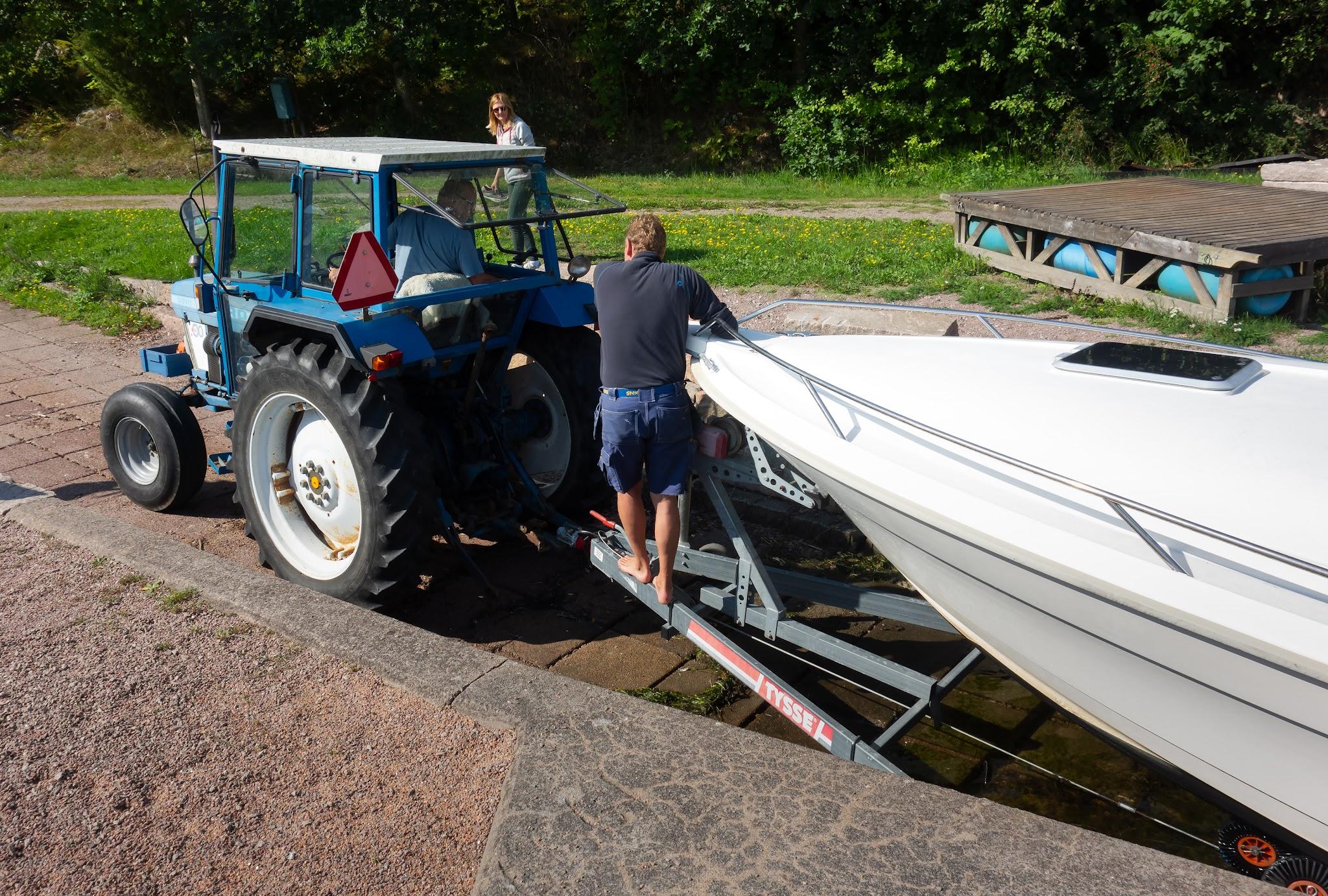
Boat hauling cost per mile is only one possible component of a road-transport quote. The complete price depends on the boat’s transport-ready dimensions and weight, whether a suitable trailer is included, loading and unloading work, origin and destination access, route and permit requirements, escorts if applicable, and scheduling. Compare complete scopes before using a per-mile figure.
Price the boat as it will travel
Give the hauler overall transport length, beam, loaded height and weight, including the support equipment. Explain which appendages can be removed and who will do that work. A model specification is a starting point; ask whether the operator needs a measured transport configuration.
For an interstate trip, the operator must assess the applicable jurisdictions and route. FMCSA securement guidance does not replace state size and permit review. Obtain the route and permit scope from the hauler instead of applying one state’s allowance to the whole trip.
FMCSA reference
Boat alone, boat on trailer, or both?
| Proposed movement | Cost question |
|---|---|
| Tow an existing trailer | Who checks road readiness and handles repairs? |
| Carry the boat on supplied equipment | Are supports, loading and unloading included? |
| Move boat and trailer as cargo | Has the combined size and loading method been accepted? |
Proposed movement: Tow an existing trailer
Cost question: Who checks road readiness and handles repairs?
Proposed movement: Carry the boat on supplied equipment
Cost question: Are supports, loading and unloading included?
Proposed movement: Move boat and trailer as cargo
Cost question: Has the combined size and loading method been accepted?
The purchase price or repair cost of a trailer is not automatically part of the hauling charge. Request it as a separate item if you need a trailer supplied or made ready.
Use a quote worksheet rather than a guessed calculator
- Base carriage: endpoints, accepted configuration and quote validity.
- Preparation: dismantling, wrapping, draining or yard labor required by the accepted service.
- Handling: cranes, travel lifts, cradles, loading appointments and receiving labor.
- Route items: permit administration and escort work if applicable.
- Delay exposure: waiting, storage, failed collection and changed dimensions.
If a quote specifies a mileage charge, confirm which miles it bills and whether there is a minimum. Do not multiply your own map distance by an advertised rate and treat the result as a booked price.
Make a cheaper offer explain its scope
Send each bidder the same measurements, condition photographs and yard contacts. Mark exclusions and unpriced work beside the total. Ask who holds custody during each lift and road segment and how damage is recorded and reported.
A low transport number can leave significant work with the owner. Choose only after both yards and the hauler agree the transfer method. This guide does not supply a live calculator, market average or promise that a particular boat can travel for a quoted rate.
Measure the boat in the configuration that will go on the road
Provide length overall, beam, transport height, weight and the position of keel, drives, rudders or other underwater gear. Include radar arches, towers, hardtops, antennas, masts or accessories that remain fitted. If an item will be removed or folded for transport, identify who does that work and what the resulting dimension becomes.
Turn this plan into comparable transport options
Use the actual vehicle, pickup and delivery details, timing and handling needs so every quote starts from the same scope.
Do not substitute a manufacturer’s dry-weight or base-model figure when the actual boat carries engines, batteries, fuel, water, tenders or installed options that materially change the load. The hauler needs the best available transport weight and dimensions to select equipment and assess the route.
Decide who supplies and is responsible for the trailer
A boat on its own roadworthy trailer is not the same job as a boat that needs a commercial transport trailer or cradle. If the owner’s trailer is part of the move, disclose its tire, brake, bearing and registration condition and ask whether the provider will tow it under the proposed service. If a specialist trailer is needed, ask how the boat is loaded, supported and unloaded and which yard equipment is required.
The boat transport planning page helps separate boat condition, trailer condition and facility responsibilities before price comparison.
Put non-mileage work beside the mileage line
Ask the quote to identify any loading or lifting charge, cradle work, permit processing, escort service, route survey, storage, waiting, marina or yard coordination and final launch or placement. A low per-mile line can coexist with substantial fixed charges. Conversely, a higher mileage figure may include work that another proposal leaves as a separate owner responsibility.
For a large vessel that may require specialized road movement, the yacht transport by road cost guide shows how route and facility work can matter as much as distance. Apply that logic only where the boat’s actual dimensions require it.
Ask what route assumptions sit behind the price
The loaded combination—not just the boat—determines whether height, width, weight or turning geometry creates a route constraint. A professional hauler should determine whether permits or escorts are required for the actual states and route. Do not infer a universal permit rule from the boat’s beam alone, and do not assume the shortest map route is the route the loaded combination can use.
FMCSA’s securement rules support the carrier’s responsibility to secure cargo appropriately, but they do not provide a consumer per-mile price or a universal tiedown recipe for every boat. Leave securement design with the responsible carrier and ask how the boat will be supported without damaging hull, running gear or fittings.
Use per-mile figures only after the scopes match
If you want to compare mileage components, first normalize the job. Use the same boat dimensions, same trailer assumption, same yards, same loading responsibility and same date window. Then divide or compare only the transportation portion if that information is actually stated. Do not reverse-engineer a total quote into a supposed industry rate when the provider has bundled fixed and variable work.
The most useful estimate shows the entire move from the boat’s current support to its accepted destination support. Mileage is a useful check inside that estimate, not a substitute for it.